What Are Legacy Health Strategies for Men Over 50, and Do You Actually Need One?
Key Takeaways
Morning stiffness and afternoon energy dips are not just "getting older" - they are strategic information your body is sending right now.
The "invisible tax" of inaction compounds silently. Chronic disease starts decades before symptoms arrive.
Willpower alone will not hold. Systematized routines are the only structure that outlasts motivation.
The difference between a forced stop and a thriving 60s is what you do in the next 12 months.
Legacy health strategies are not about ego or fitness. They are about protecting the vessel that carries your leadership, your family, and your future.
You notice it in the mornings. That extra stiffness when you get up. The way the first hour of the day takes a bit more effort than it used to. By afternoon, the energy that used to carry you clean through to knock-off time has dropped off, and you find yourself pushing through on sheer stubbornness.
You have probably told yourself it is just the season. A busy patch. Getting older. No big deal.
But here is the honest truth: those small signs are not random inconveniences. They are early warning signals. And for men over 50 who work hard - physically, mentally, or both - ignoring them is one of the most expensive decisions you can make. Legacy health strategies are not something you build in a crisis. You build them now, when the sun is still shining and the roof still holds.
Who this is for: This article is for hard-working men aged 40 to 60 - farmers, tradies, contractors, and manual professionals - who are starting to notice the signs of wear but have not yet taken a structured approach to their long-term physical capability. If you are asking whether now is the right time to act, this is for you.
What Is a Legacy Health Strategy, and Why Does It Matter for Men Over 50?
A legacy health strategy is a proactive, structured approach to protecting your physical capability over the long term. It is not a fitness programme for ego or performance. It is a system that keeps your body reliable, pain-free, and capable of doing what you need it to do - at 55, at 65, at 75.
Think of it like I often explain it to clients: "I am like a retirement planner for your body. You have got an accountant for your finances and a mechanic for your gear. I help make sure your body lasts long enough to enjoy what you have worked for."
For men over 50, especially those who have spent decades in physically demanding work, this kind of structured planning is not optional. It is the difference between staying in the game and being forced out of it.
Why the Small Signs Are Never Small
There is a pattern that plays out the same way for nearly every hard-working man in his 50s. The morning stiffness gets written off. The afternoon slump gets managed with another coffee. The weekends that used to be for family and adventures quietly become recovery days.
This is what I call "The Drift."
The Drift is not a dramatic event. It has no single moment you can point to. It is the slow, steady accumulation of small compromises - patterns your body memorises and begins to accept as normal. Without active intervention, your body follows the path of least resistance. And at 50-plus, that path runs downhill.
The stiffness you feel every morning is not just tight muscles. It is physiological friction. A signal that recovery is not keeping pace with demand. The afternoon slump is often a deficit - in minerals, hydration, mitochondrial health, or structured rest. These are not complaints. They are data. The question is: are you reading them?
What Happens When You Keep Ignoring the Signals?
I think about Nick a lot when I have this conversation.
He came to me waking up tired. Not after a big week. Not after a late night. Every morning. And what made it worse was the thought that came with it - this is what they warned me about, and now it is happening to me. So he did what most driven people do. He pulled back. Less training, more space. That should have fixed it. But after weeks of doing less, nothing changed.
And that is the moment I have seen catch so many men off guard. Because now we knew this was not about doing too much. It was the opposite. I have seen this pattern too many times - not just with Nick but with high performers right across the board. We assume the problem is load. But it rarely is. High performers do not burn out from doing too much. They burn out from under-fueling the load.
So instead of asking Nick to do less, we changed the question. Not "How do we reduce demand?" but "Does his body actually have the capacity to support this life?" That shift changed everything. Recovery improved. Energy stabilized. Mornings stopped feeling like a grind. And training came back in - not as pressure, not as another demand on an already full life, but as the reset he had been missing. What he thought he needed to remove turned out to be one of the things keeping him at his best.
Here is what that story illustrates about the bigger picture. The four major threats to long-term health - heart disease, cancer, neurodegeneration, and metabolic disease - develop quietly over decades. By the time you feel pain or receive a diagnosis, the window for early intervention may already be closing. Every year you wait, entropy wins a little more ground. The real cost is not just physical. It is the missed milestone with the kids. The business decision made through brain fog. The weekend that should have been an adventure but ended up horizontal on the couch because your body had nothing left.
And without a system that changes the underlying structure of your daily life, you will keep oscillating - working hard on your health until the acute pain goes away, then drifting back until the next flare-up forces you to start again. That is not failure. It is a structural problem. And it requires a structural solution.
What Does a Systemized Legacy Health Strategy Actually Look Like?
A legacy health strategy is the shift from reactive to proactive, acting before pain forces change. It’s treating your body the same way you treat your best piece of gear. You wouldn’t run a vehicle into the ground and wait for the breakdown to start servicing it. You service it because you need it to perform under load. Your body deserves the same respect.
In Future Fit, a well-structured plan for men over 50 isn’t “more training.” It’s a five-system strategy that keeps your capacity growing as life stays demanding:
1) Signals & Awareness
You learn to notice the early indicators - tightness, fatigue, stiffness, hesitation, sleep changes - and respond while the cost is still low. The aim isn’t to avoid effort. It’s to stop ignoring the warnings until the body has to shout.
2) Load
You build a weekly rhythm that matches the life you actually live: work, stress, travel, sport, family. Load isn’t just workouts - it’s total demand. A legacy strategy manages spikes, spaces effort, and progresses intentionally so you don’t “pay for it afterwards.”
3) Coordination
You prioritize movement quality under real conditions: balance, symmetry, control, and efficiency. Coordination is what keeps force moving through the right places - so the knee, back, neck, or shoulder doesn’t quietly become the weak link.
4) Recovery
Recovery is planned, not accidental. It’s not just rest - it’s returning to baseline so capacity can rebuild. Sleep quality, genuinely easy days, downshifts, and nutrition are treated as part of training, not optional extras.
5) Adaptation
This is the long game: your body becomes more capable over time, not just “maintained.” Strength, aerobic base, and tissue tolerance are progressed in a way that compounds. You’re building margin - the extra capacity that gives you freedom in your 60s and beyond.
That’s what a systemized legacy health strategy looks like: not a collection of workouts, but a framework that keeps your body reliable under load, and improving year on year.
What Is the Difference Between a Systemized Longevity Plan and a Generic Gym Membership?
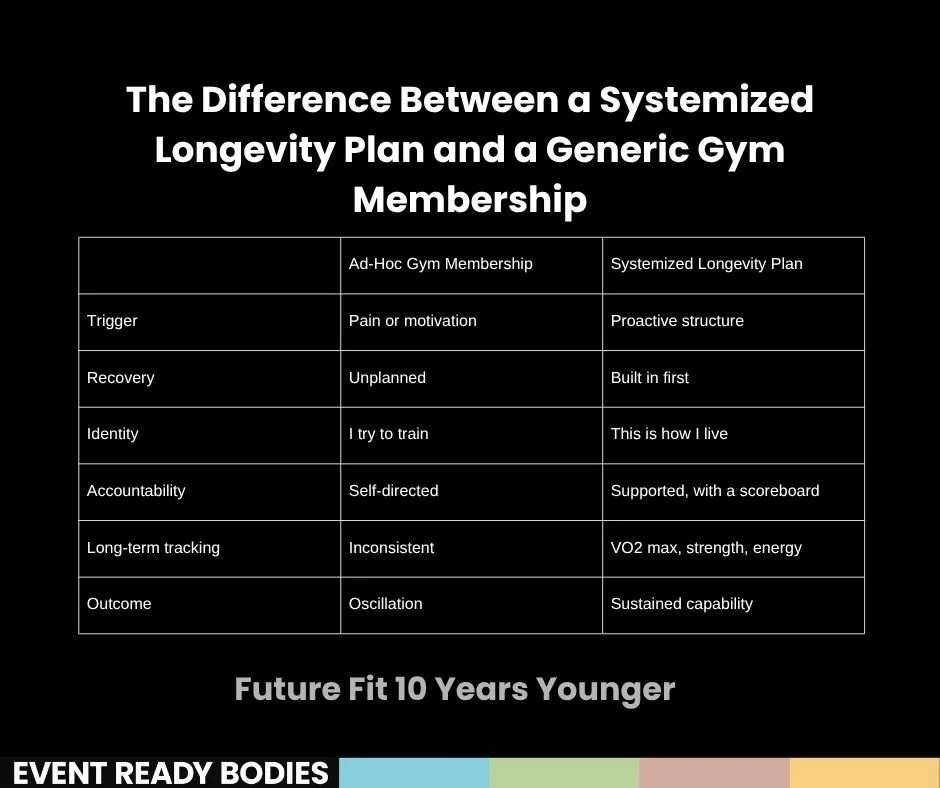
Ad-Hoc Gym v’s Systemized Longevity Plan
The Future Fit programme by Event Ready Bodies was built specifically for this reality. It is a 30-week integrated system designed for high-demand manual professionals - farmers, tradies, contractors, leaders - who need their body to perform, not just to exist. Clients who commit report something they did not expect: within months, training stops feeling like a chore and becomes part of who they are.
Nick Walkley put it this way: "Future Fit by Event Ready Bodies has helped me gain back flow in my life. My increased fitness has helped me achieve more for my family, business, and adventure racing events. So worthwhile."
Conclusion
The small signs you are noticing are not noise. They are a message. The drift is real, it is progressive, and it is entirely reversible - if you act before it becomes a forced stop.
Legacy health strategies for men over 50 are not about ego or performance culture. They are about protecting the vessel that carries your leadership, your family, and everything you have worked to build. A structured, systemized approach changes the riverbed of your life so that vitality becomes the natural path - not something you fight for every Monday morning.
I have spent over a decade working with the men who keep industries, farms, families, and communities running. I was born on a farm in Turakina, I still live on the land, and I understand what it means when the body starts whispering - and you keep working anyway.
You have already made it this far by looking after what matters. Now it is time to look after yourself.
Take the Boots Certainty Check
You service your gear because you need it to perform under load. Your body deserves the same thinking. The Boots Certainty Test is a short, practical window into single-leg balance, coordination, and control - one of the clearest indicators of reliability in everyday life. This is not about fitness. It is about certainty. Can your body do what you expect of it - without thought, pain, or doubt?
Find out. Visit www.eventreadybodies.co.nz/the-boots-test and take the Boots Certainty Check today.
Further Reading
Why Am I Still Tired Even After Resting? - Understand what your body's early signals are actually telling you.
Are You Relying More on Grit Than Recovery to Keep Going? - How "body drift" quietly affects manual professionals and what to do about it.
Why Is Recovery Essential for Manual Professionals? - Why recovery is not weakness - it is your most strategic tool.
The Quiet Decline You Cannot Afford to Ignore - The silent progression that catches most hard-working men off guard.
Frequently Asked Questions
What are the first signs that a man over 50 needs a legacy health strategy?
The earliest indicators are usually morning stiffness that takes longer to clear, afternoon energy drops that feel like a pattern rather than a one-off, slower recovery after physical effort, and weekends that become recovery time rather than quality time. These are not signs of inevitable decline - they are strategic information. They signal that your body's systems need structural support, not just willpower.
Why do most health programs fail busy manual professionals over 50?
Most programmes are built for younger bodies with predictable schedules. They do not account for the physical load accumulation of manual work, the demands of leadership, or the shift in recovery kinetics that comes with being over 50. Without planning recovery first and building a structure that fits a real, demanding life, most programmes become another oscillation cycle - good weeks followed by collapse whenever life gets busy.
What is the difference between healthspan and lifespan, and why does it matter?
Lifespan is how long you live. Healthspan is how long you live well - with strength, mobility, energy, and independence. The goal of legacy health strategies is to close the gap between the two. Most chronic diseases develop silently over decades. Proactive investment now means more capable, active, quality years later - not just more years on the clock.
How does the Future Fit program differ from a standard gym membership or physio plan?
Future Fit is a 30-week integrated longevity system built specifically for high-demand manual professionals aged 40 to 60. Unlike a gym membership, it prioritizes recovery planning first, builds in structured strength and mobility work calibrated to your workload, and tracks meaningful long-term metrics like VO2 max and strength. It is supported, personalized, and grounded in both clinical exercise science and real-world rural experience. You can learn more at Future Fit by Event Ready Bodies